Working Principle of Ribbon Blender:
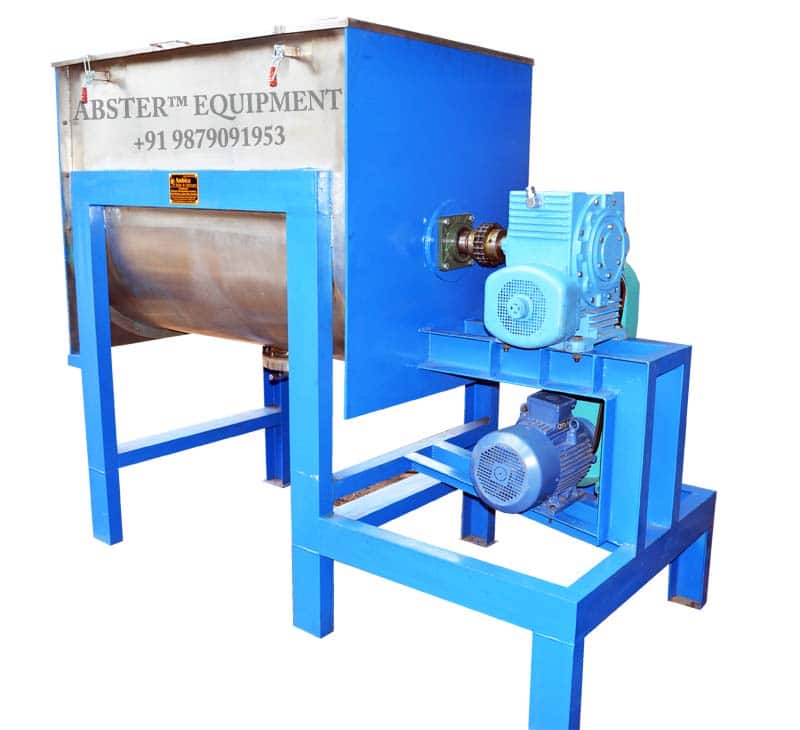
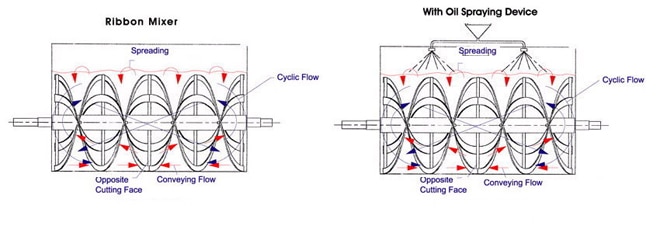
Ribbon Blender (also named ribbon mixer) is a basic industrial mixing machine. They consist, basically, of a trough-shaped shell (usually 2 to 3 times longer than it is wide) with a semicircular bottom, fitted with a horizontal longitudinal shaft on which are mounted arms supporting a combination of ribbon blades, paddles or helical screws set at a fairly close clearance to the semicircular mixer body so that no layer of material remains on the bottom of the ribbon mixer. The most effective design of ribbon layout is the double spiral in which the outer ribbon moves the product in one direction and the inner ribbon moves it in the opposite direction.
The ribbons rotate and move materials both radially and laterally to insure thorough blends in short cycle times. Ribbon agitators are used for blends that will be between 40 and 70% of the rated capacity of ribbon blender.
Advantages of Horizontal Ribbon Blender
- Mild mixing which will not break the physical size of material
- More loading factor:ribbon blender’s working volume is between 40%-70% of the total nominal volume, but generally speaking, 60% is maximum loading ratio of ribbon blender when mix heavy bulk density material
- Easy Cleaning: usually, the opening at ribbon blender’s top cover is very large to touch into the inner surface for cleaning purpose.
- Easy Maintenance: the structure of ribbon blender is very simple, easy to dismantle and maintenance
- Low Power Energy