
| Model | Atmospheric and open type |
|---|---|
| Drum dimension | ø400 × 500 L (surface area: 0.625m2) |
| Drum cooling method | Double drum cooling |
| Drum material | SUS304+hard chromium plate |
| Drum rotation speed | 0.2 ~ 15rpm |
| Available type | Any of the dip-feed, side-feed, top roll feed types can be tested. |
Sigma Mixer Kneader, Sigma Mixer Machine Sigma Blade Mixer
- 24A, Laxmi Industrail Estate, Amraiwadi
Drum Flaker
Rotary Drum Flaker Drum Flaker has a High quality condensation rotary drum flaker can make the heated fluid which is…
Rotary Drum Flaker
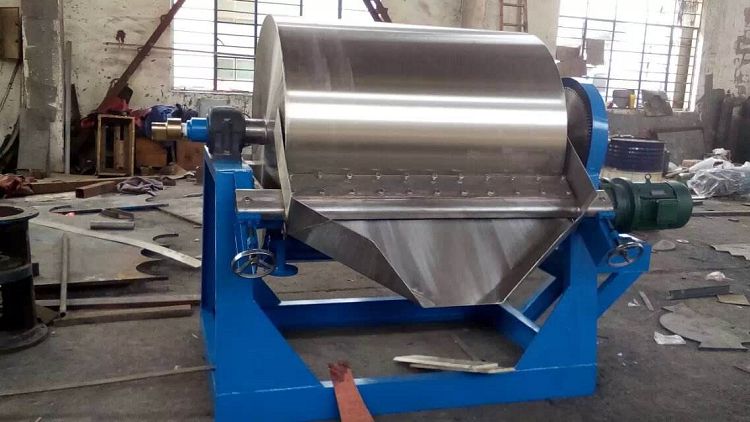
Drum Flaker has a High quality condensation rotary drum flaker can make the heated fluid which is in trough to stuck on the revolving cooling roller through the rotation of the cooling roller firstly, then cut it into flakes through adjustable scraper. Thus it completes the conversion from liquid to solid flakes. It is widely used in chemical and pharmaceutical and other industries.
Product Description
High quality condensation rotary drum flaker can make the heated fluid which is in trough to stuck on the revolving cooling roller through the rotation of the cooling roller firstly, then cut it into flakes through adjustable scraper.
Thus it completes the conversion from liquid to solid flakes.
It is widely used in chemical and pharmaceutical and other industries.
The drum flaker improves the quality of the final flakes product compared with the product made by crusher.
Furthermore, this machine is easily to operate with good quality.
The thickness and output of this flaker depends on the raw material characteristics, drum speed and feeding speed.
The flake specifications can be customized.
Applications of rotary drum flaker
1. For continuous drying of viscous, pasty and sticky materials in food, chemical and pharmaceutical industry.
2. Heating area: 1.12-10.6 M2
3. Evaporation capacity: 40-60 kg water / hour
4. Working type: continuous
5. Heat source: steam
Technical Advantages
1) High heat efficiency: Heat loss is mainly caused thermal radiation. Heat efficiency can be as high as 90%.
2) Short drying time: The drying process only takes 10-15 seconds. So drum dryer can be used for drying heat sensitive material.
3) Uniform drying: Heat transfer direction and coefficient all over the drum surface are the same. And wet material can be evenly spread over the drum surface. Wet material can be uniformly dried.
4) Long life span: Rotary drum is electro polished and well heat treated to increase the smoothness and hardness.
5) Flexible application: Drum surface temperature, rotating speed, wet material film thickness are all adjustable to satisfy materials with different moisture and drying time.
6) Compact size: The drying chamber is very compact in size. Only need small installation space.
7) Low operation cost: The whole machine is very simple and reliable. It can be used for many years with little repair and maintenance.
8) Highest hygienic standard: Indirect heating and electro polished drum surface can assure highest hygienic working conditions.
Drum flaker machine working principle
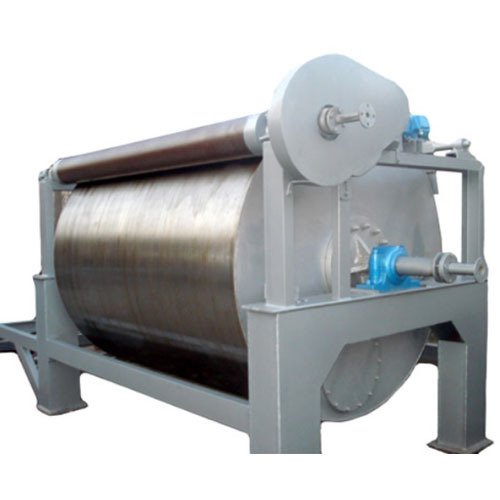
The hot material is applied to the cooling drum by direct immersion into a trough, or indirect immersion using doctor/applicator rolls. The molten liquid is cooled on the cooling drum and after a partial revolution; the cooled and solidified product is removed by a scraper in the form of flakes or film. The cooling drum of the flaker is specially designed to provide an even cooling effect by having uniform and effective internal distribution. As a result, both high output and homogeneity of the product are possible.
The drum flaker transforms a molten product into a solid. The process that takes place is a solidification and/or crystallization process. The product begins to solidify the moment it comes into contact with the cold, rotating drum. After one revolution the completely solidified layer is removed from the drum by a knife and typically breaks into easy to handle Flakers.
The form and size of the Flakers depend on the nature of the product, but also to some extent on the process conditions.
Abster has of specialty machines. The surface can also be furnished with special grooves for products with poor adhesion properties. There are three designs of Drum Flakers Dryer as below:
1. Dip Feed Drum Flakers Dryer
For products with low viscosity and good adhesion properties a drum flaker with dip pan is used. In this type the rotating drum runs continuously through the heated melt in the dip pan underneath the drum.
2. Overhead Applicator Roll Drum Flakers Dryer
For product with moderate to high viscosity, the overhead applicator roll is used. A heated applicator roll is positioned above the cooling drum. The melt can be easily fed via the trough-shaped nip between the applicator roll and the cooling drum. Contact with the hot applicator roll ensures that the product remains liquid.
3. Twin Drum Flakers Dryer
Drum dryers are of conductive heat-transfer type. A heating medium (generally steam) is sent into the rotating drum (cylinder) and liquid material is fed on the heated drum to evaporate and concentrate, and concurrently the liquid material is stuck on the drum surface in the form of a film, then promptly evaporated and dried. Dried materials are scraped continuously with a stationary knife.
Drum dryers are roughly classified into an atmospheric type and vacuum type according to operating pressures, and also, they are classified into a double drum type, twin drum type, and single drum type according to the number of drums.
Further, the single drum type is classified into a dip type, spray type, splash type, top roll type (single-stage, multi-stage), side roll type, below roll type, etc. according to the liquid feeding methods. These classifications are based on the trial for making materials adhere to the drum surface more uniformly and efficiently.
The Drum Flaker enables processing of molten products into excellent quality Flakers. The well-considered concept of the drum flaker has led to a number of features :
- Compact unit, little floor space required;
- Completely closed cooling system, absolutely no cross-contamination between cooling medium and product;
- Low operational and maintenance costs
- Gastight enclosures
- Easy inertisation of the process;
- Unit designed with good access for maintenance and cleaning
- Construction material ranges from carbonsteel to various grades of stainless steel, Hastelloy, etc.
- Operation is continuous, allowing products of stable quality.
- Drying time is short and materials are not exposed to high temperatures for a long period, making materials which are sensitive to heat possible to dry well.
- Drum dryers are devices which are rational in most to perform evaporation and drying at the same time.
- Because the drum dryer is a heat-transfer drying system, its thermal efficiency is better than that of the other type of dryers and it is very economical.
- Because no liquid is left inside at shutdown, processing is possible to the last one drop.
- Performance adjustment is easy to carry out extensively, allowing one person to manage several units.
- Cleaning in the dryer is simple, making a change of application easy.
- Description
- Applications
- Working Principles
- Features
The drum flaker is used primarily to process chemical and pharmaceutical products. However, more and more applications for these machines are also being found in the food industry.
The required flake size is achieved by controlling circumferential speed, layer thickness, and knife angle. Careful design ensures optimum use of the drum surface area to maximize capacity at the chosen operating conditions. The drum flaker is primarily used to produce Flakers, but there are also ways of converting your product into easily manageable pastilles or prills.
Abster Equipment’s Drum Flakers dryer is specially developed for vast range of applications :
- Textiles Industries
- Pharmaceuticals Industries
- Food products
- Chemicals Industries
- Paper Industries
- Pigments
- Starch Products
- Pesticides and fertilizers
- Adhesives Industries
- Many Other Drying Applications.
The drum flaker transforms a molten product into a solid. The process that takes place is a solidification and/or crystallisation process. The product begins to solidify the moment it comes into contact with the cold, rotating drum. After one revolution the completely solidified layer is removed from the drum by a knife and typically breaks into easy to handle Flakers.
The form and size of the Flakers depend on the nature of the product, but also to some extent on the process conditions.
Techno Enterprise has a range of specialty machines. The surface can also be furnished with special grooves for products with poor adhesion properties. There are three designs of Drum Flakers Dryer as below:
1. Dip Feed Drun Flakers Dryer
For products with low viscosity and good adhesion properties a drum flaker with dip pan is used. In this type the rotating drum runs continuously through the heated melt in the dip pan underneath the drum.
2. Overhead Applicator Roll Drum Flakers Dryer
For product with moderate to high viscosities, the overhead applicator roll is used. A heated applicator roll is positioned above the cooling drum. The melt can be easily fed via the trough-shaped nip between the applicator roll and the cooling drum. Contact with the hot applicator roll ensures that the product remains liquid.
3. Twin Drum Flakers Dryer
Drum dryers are of conductive heat-transfer type. A heating medium (generally steam) is sent into the rotating drum (cylinder) and liquid material is fed on the heated drum to evaporate and concentrate, and concurrently the liquid material is stuck on the drum surface in the form of a film, then promptly evaporated and dried. Dried materials are scraped continuously with a stationary knife.
Drum dryers are roughly classified into an atmospheric type and vacuum type according to operating pressures, and also, they are classified into a double drum type, twin drum type, and single drum type according to the number of drums.
Further, the single drum type is classified into a dip type, spray type, splash type, top roll type (single-stage, multi-stage), side roll type, below roll type, etc. according to the liquid feeding methods. These classifications are based on the trial for making materials adhere to the drum surface more uniformly and efficiently.
The Drum Flaker enables processing of molten products into excellent quality Flakers. The well-considered concept of the drum flaker has led to a number of features :
- Compact unit, little floor space required;
- Completely closed cooling system, absolutely no cross-contamination between cooling medium and product;
- Low operational and maintenance costs
- Gastight enclosures
- Easy inertisation of the process;
- Unit designed with good access for maintenance and cleaning
- Construction material ranges from carbonsteel to various grades of stainless steel, Hastelloy, etc.
- Operation is continuous, allowing products of stable quality.
- Drying time is short and materials are not exposed to high temperatures for a long period, making materials which are sensitive to heat possible to dry well.
- Drum dryers are devices which are rational in most to perform evaporation and drying at the same time.
- Because the drum dryer is a heat-transfer drying system, its thermal efficiency is better than that of the other type of dryers and it is very economical.
- Because no liquid is left inside at shutdown, processing is possible to the last one drop.
- Performance adjustment is easy to carry out extensively, allowing one person to manage several units.
- Cleaning in the dryer is simple, making a change of application easy.