
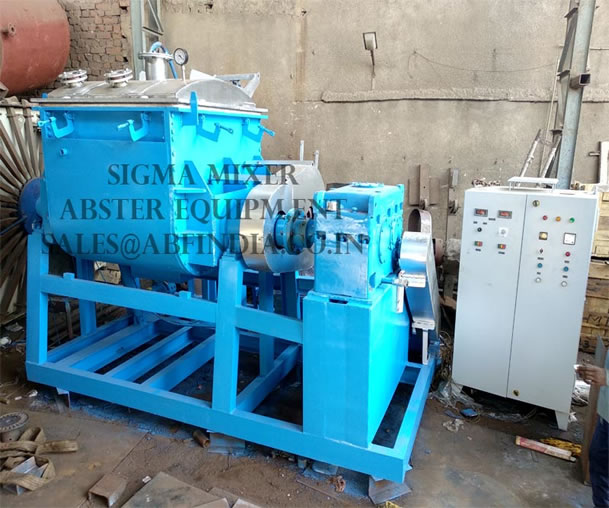
Sigma Mixer Kneader, Sigma Mixer Machine Sigma Blade Mixer

300L hydraulic tilt Vacuum Double Z Blade Sigma mixer

300L hydraulic tilt Vacuum Double Z Blade Sigma mixer Specification Double sigma mixer is used to knead, mix, crush, disperse…

Specification

Double sigma mixer is used to knead, mix, crush, disperse and re-polymerize high viscosity paste or elastoplastic materials, which can not be processed by the general powder mixers and liquid blenders.
Double sigma mixer is the ideal equipment for all kinds of chemical products and has the merits of stirring evenly, kneading efficiently and no dead corner.
The materials are scraped, stretched, folded and squeezed among the blade, slot wall, and ridge-like protrusions. The materials cycle from one end of the impeller to the other. The two mixing paddles are tangent and spin at different speeds to complet the kneading process. Tilt the solt to discharge the materials.
Double sigma mixer is used to knead, mix, crush, disperse and re-polymerize high viscosity paste or elastoplastic materials, which can not be processed by the general powder mixers and liquid blenders
Double sigma mixer is the ideal equipment for all kinds of chemical products and has the merits of stirring evenly, kneading efficiently and no dead corner.
The materials are scraped, stretched, folded and squeezed among the blade, slot wall, and ridge-like protrusions. The materials cycle from one end of the impeller to the other. The two mixing paddles are tangent and spin at different speeds to complet the kneading process. Tilt the solt to discharge the materials.

The parts of the cylinder and the blade that contact with the materials are made of stainless steel, to ensure product’s quality.
The kneader can be used for the high-viscosity paste or plastic solid with poor mobility around 5000PA. S, and the jacket can be heated or cooled by the heat transfer oil or water.
According to the special needs, the plant can be designed to operate in a vacuum. The speed difference between the biax is 7.52r/min, so that the material is constantly changed, fastly mixed and has a larger transfer area for unit volume.

Application:

Chemical Industry:

Silicone resin, Sealant, Silicon rubber, Silica gel, Hot melt adhesive, Butyl rubber, Glass cement, BMC / CMC, Pigment, Plastics, Dyestuff, Ink, Fiber paste, Aluminum silver paste, Paper pulp, carbon material, battery paste. Tooth paste, Clay, Polyethylene, Pitch coating coke, Coal tar pitch etc.

Food Industry:

Chocolate, Bubble gum, dough, chewing gum, soft candy, cheese etc.

Pharmaceutical:

Discharge Way: Hydraulic tilt; Screw extruding ,Bottom valve.

Heating: Electric heater heating; Circulation oil heating or Steam heating.

Material: SUS304/S.S316/Mild steel. Customized according to client’s request.

Capacity: 2-5000L

Dispersion Rubber & Plastic Kneader

In Sigma mixer tangential action of mixing and kneading obtained by ‘Z’ type (SIGMA) shaped kneading blades, which rotates very accurately at different speed towards each other causing product to be transferred from one end to another end. Discharge of the finished product is achieved by tilting the container or through the valves at the bottom or by means of an extrusion screw beside the container.

The mixing action is a combination of bulk movement, stretching, folding, dividing, and recombining of the material. The shearing & tearing action of the material against blades and the side walls causes size reduction of the solids. After the time period required for sterilizing the batch has elapsed, the heating circuit shuts of the pneumatics damper (exhaust) opens and cooling operation commences.

In the tangential design, the blades rotate in the trough meeting tangentially. The front blade generally rotates faster than the rear blade usually in the ratio of 3:2. Tangential blades are generally used for material of higher viscosities such as adhesives, rubber compounds, flush colors, dyes, and pigments.
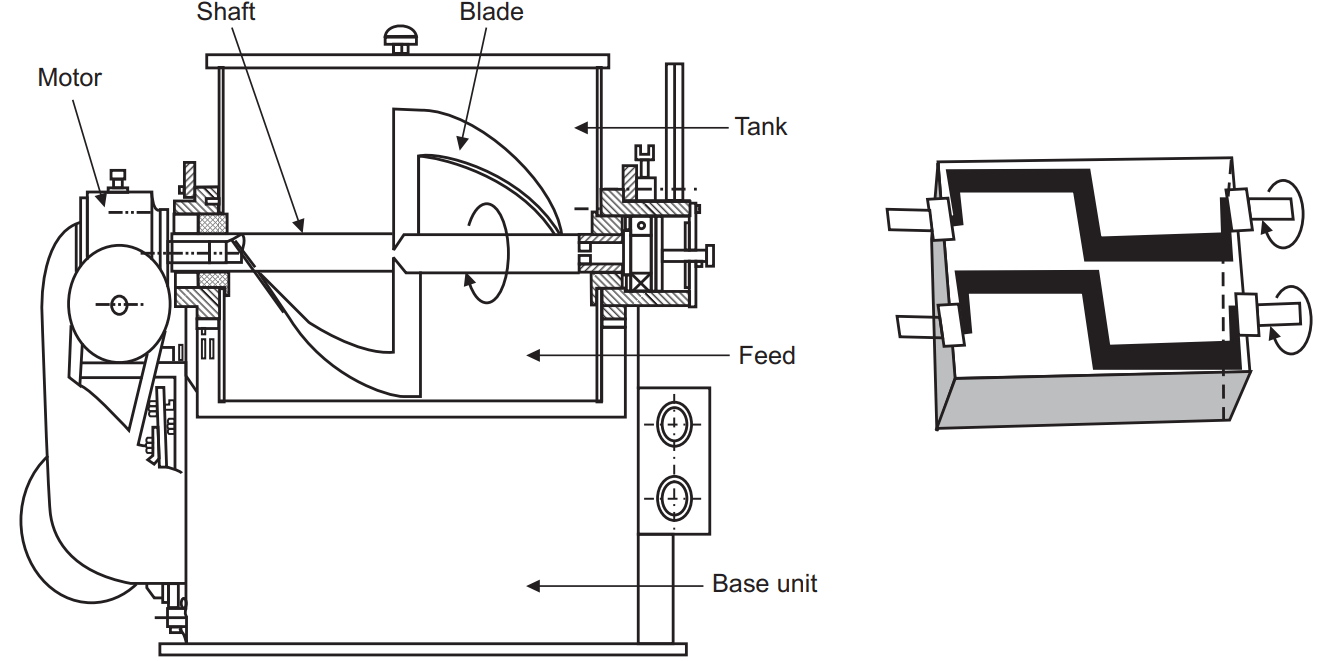
In the overlapping design, the blades overlap above the saddle of the container. Due to the overlapping action, it is necessary that the relative position of the two blades is unchanged, and as a result, both the blades rotate at the same speed. Materials that flow freely or creep down into the blades are mixed using the overlapping blade action. This design offers a faster interchange of material from one blade compartment of the mixer to the other. Overlapping blade action is used for materials of lighter viscosities such as carbon pastes, clay coating, creams, and ointments. The overlapping blade produces a lower kneading and shearing compared to the tangential blade action.